2025-06-20
FOREIGN LITERATURE
|
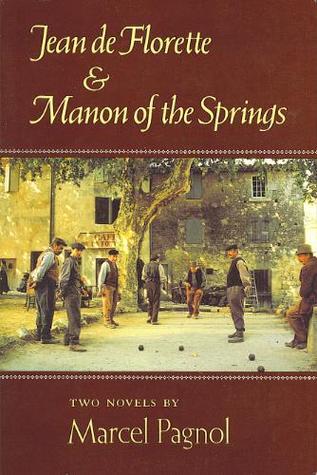
Manon of the Springs
by Marcel Pagnol
Publisher Note:
TLD : As with the previous book, Jean de Florette, I'm excluding a description of this book, the second in the series, because for any who might want to read it, I don't want to spoil the experience for you. Just know that I would recommend it and I would recommend you go in blind.
Troy Note:
This is the sequel to Jean de Florette. It is not at all what I expected, or maybe hoped for, but proved better than my basic wishes. Further, it has one of the most surprising and satisfying endings I can remember. Fact is, the ending was so good, I was tempted to turn back to page one (of the first book!!!) and launch into an immediate reread of both books just to experience the story with this new knowledge in hand.
Who would have ever thought two groups warring over a french hillside, one to grow carnations, the other to raise rabbits, could be so compelling? Evidence of something I've always believed: there is beauty in the mundane.
Passage(s) of Note:
Thus adorned, he crept up to the edge of the bluff: with his chin poised on the edge, between two stones, he watched her living her life.
She spent some hours on the flat rock, in the shade of the single branch of the hunchbacked mountain ash. She read, she dreamed, she sewed multicolored materials, or slowly combed her hair ... Suddenly she would get up and hurl stones with her sling, or dance around the mountain ash, dropping curtseys to it. Sometimes she would call the black dog and patiently extract minute thistles from his fur and the sly insects that crept into his ears, and sometimes even into his nostrils ... When she finished Bicou's toilet she took the shaggy cheeks of the liberated dog between her two hands and talked to him eye to eye. Ugoliin was too far away to hear the things she said to him. They certainly were secrets, and perhaps worse, because black dogs, especially those with eyes covered with hair, have never had a good reputation.
Besides that, nearly every day he observed another ceremony, much more surprising. Toward eleven o'clock she would call the big white she-goat and draw a little milk in a tin plate, which she put beside her on the flat rock ... Then she would put her lips to the mouth organ and play an ancient air, always the same, a long phrase, shrill and fragile, which hardly disturbed the pure silence of the vallon: then the great "limbert" of Les Refresquieres, the green lizard, spotted with gold and blue, would leap out from a distant bramble thicket. Like a streak of light it would run toward the music and plunge its horny snout into the bluish milk of the hills.
This limbert had been known in the village for years because of its size, nearly a meter long. It was said to have the eyes of a serpent and to mesmerize little birds, which fell alive into its open jaws. Its forked tongue would lap the milk, but when the mouth organ stopped, it would raise its flat head toward Manon. Then she would smile and speak softly to it. Ugolin, uneasy and charmed, looked at the long glistening beast listening to the luminous girl, and thought: "The old people weren't very wrong when they said she was a witch!"
But one day he murmured, smiling with pleasure: "When a witch is pretty, well then she's called a fairy!"
He took the ribbon, looked at it, caressed it, kissed it, then suddenly got up to open the drawer of the little cupboard. There he found some thread and a needle, which he did not find easy to thread. He took off his shirt, sat with his chest bare on a chair near the lamp, and started to sew the green ribbon onto his left breast. The needle was thick and the blood spurted out in drops. He clenched his teeth and pulled on the rough double thread, tearing his flesh. Four times he pushed the needle in and drew the thread tight. The fifth time he pierced only the ribbon and tied a dressmaker's knot. Finally, his face pale and drenched with sweat and tears, he took the piece of mirror from the wall and gazed at the blood-spattered green ribbon hanging from the soft red hair on his chest.
"That way," he said, "it will always be over my heart."
"If I haven't got my water tomorrow, I'll come back and set fire to the place!"
"I advise you," replied the mayor, "to carry a match that's longer than the handle of this mallet!"
"When I was young (my father was a peasant like you in a little hamlet near Sisteron) we had a cousin named Adolphin. He lived in another village not far from ours, but nevertheless, he never came to see us, not for fetes, nor for births, nor even for deaths. But from time to time (about once a year) I would hear my father say, 'Well, look, Adolphin's turned up. He must want something!'
"Adolphin would come up the path, in his Sunday best. He would make friendly remarks, pay compliments, and talk about the family until he brought tears to our eyes. And then, when he had embraced everybody, as he was leaving, he would say, 'By the way, Felicien, you haven't got a plough you could spare? I broke mine on the stump of an olive tree.' Another time it was a bundle of vine shoots for his grafts--because my father made a famous wine--or then his horse had the colic and he wanted to borrow the mule. My father never refused, but I often heard him say: 'Adolphin, he's not a good character!'"
He leaned over the edge of the pulpit, swept the audience with his eyes and said forcefully:
"Well, my friends, what you are doing today to the Good Lord is Adolphin's kind of trick! He hardly ever sees you, then suddenly you all arrive, with your hands joined, full of emotion, all bursting with faith and repentance. Go! Go, you band of Adolphins! Don't imagine the Good Lord is more naive than my poor father, that he doesn't understand you right down to the very bottom of your petty spitefulnesses! The Good Lord knows very well that there are quite a few here who have not come to offer Him sincere repentance, or to take a step on the way to their eternal salvation!...He knows very well that you are here because the spring is not flowing anymore!"
|